 US Dollars


Long before onshoring became a supply chain strategy for the thermal management industry, it was simply how Wakefield Thermal did business.
We've been manufacturing domestically since 1957. While much of the manufacturing industry spent the past several decades shifting production overseas in pursuit of lower costs, we continued investing in domestic manufacturing, engineering, and production capabilities.
Across our U.S. operations, we've built up the ability to extrude, machine, bond fin, finish, assemble, and engineer thermal solutions within our own manufacturing network.
Today, the market is finally moving in our direction.
Tariffs, transportation disruptions, geopolitical uncertainty, and unpredictable shipping schedules are forcing manufacturers to reconsider the true cost and risk of importing critical components. Companies across the industry are now working to establish domestic capabilities that we have spent decades evolving.
For Wakefield, this isn't a pivot toward onshoring. It's validation of the manufacturing strategy we have maintained since 1957.

Understanding Onshoring in the Thermal Industry
Onshoring means moving manufacturing processes and supply chains back to the domestic market where products are ultimately needed. In thermal management, however, meaningful onshoring requires more than performing final machining or assembly in the United States while continuing to depend on imported materials or semi-finished components.
True domestic capability requires control over the processes that determine how a thermal solution is designed, manufactured, modified, and delivered.
That distinction is particularly important for aluminum-based thermal products.
The tariff environment provides one example. In June 2025, Section 232 tariffs on many imported aluminum and aluminum derivative products increased to 50%. Subsequent changes to U.S. trade policy have continued to demonstrate how quickly the economics surrounding imported metal products can shift. For manufacturers sourcing aluminum-intensive products overseas, a supply strategy that makes financial sense when a program launch may look very different when tariff policies change.
Shipping delays induced by weather shocks add another layer of uncertainty. Research from the Federal Reserve Bank of New York found that unexpected ocean shipping delays (caused by increased weather risks) can negatively affect the revenues, profits, and employment of U.S. manufacturing importers. Manufacturers exposed to greater shipping risk responded by diversifying routes and foreign suppliers, but they ultimately reduced their overall imports.
Recent disruptions have made that risk tangible. Fallout from the COVID pandemic that strained port infrastructure. The 2021 Suez Canal blockage. Geopolitical tensions in the Red Sea. Drought-related restrictions in the Panama Canal. International port congestion. Climate change. These and other events have demonstrated how quickly a shipment that appears predictable on a spreadsheet can become anything but.
For thermal components tied to a production schedule, that uncertainty matters.
Why a Domestic Supply Chain Matters
The strongest argument for domestic manufacturing isn’t simply that a product is “Made in the USA.” It’s about control.
Consider a custom extruded heat sink manufactured overseas. The supply chain may involve one supplier producing the extrusion, another completing machining or finishing, an international freight provider moving the product, customs clearance, domestic transportation, and finally delivery to the customer.
Every additional handoff introduces another variable. Our vertically integrated domestic manufacturing model reduces those variables.
Domestic vertical integration compresses that supply chain. Because we control critical manufacturing processes internally, coordinating extrusion, machining, finishing, engineering, and assembly within the same manufacturing organization, we can respond faster when designs change, provide greater visibility into manufacturing schedules, and reduce reliance on outside suppliers.
That proximity can also affect inventory strategy. Long international replenishment cycles often require manufacturers and distributors to carry additional safety stock to protect against transportation delays. A shorter domestic supply chain can provide greater flexibility to replenish inventory as demand changes rather than forecasting requirements months in advance.
When products are manufactured domestically, customers can reduce exposure to tariffs and many transportation risks that are associated with importing finished thermal products.
We're not trying to build these advantages from scratch. They've been embedded in a manufacturing infrastructure we've been developing for generations.
Building a Vertically Integrated Domestic Thermal Supply Chain: Doubling Down on What We've Always Done
This is where Wakefield Thermal’s manufacturing model becomes increasingly relevant.
Wakefield is the only U.S.-based thermal management provider with its own in-house aluminum extrusion capability. Its U.S. operations combine extrusion, CNC machining and milling, bonding, soldering, assembly, finishing, and engineering support within a vertically integrated manufacturing footprint.
Today, we have approximately 500,000 square feet of U.S. manufacturing capacity, while our extrusion operations include multiple presses and capacity exceeding 53 million pounds annually.
That domestic foundation is now expanding.
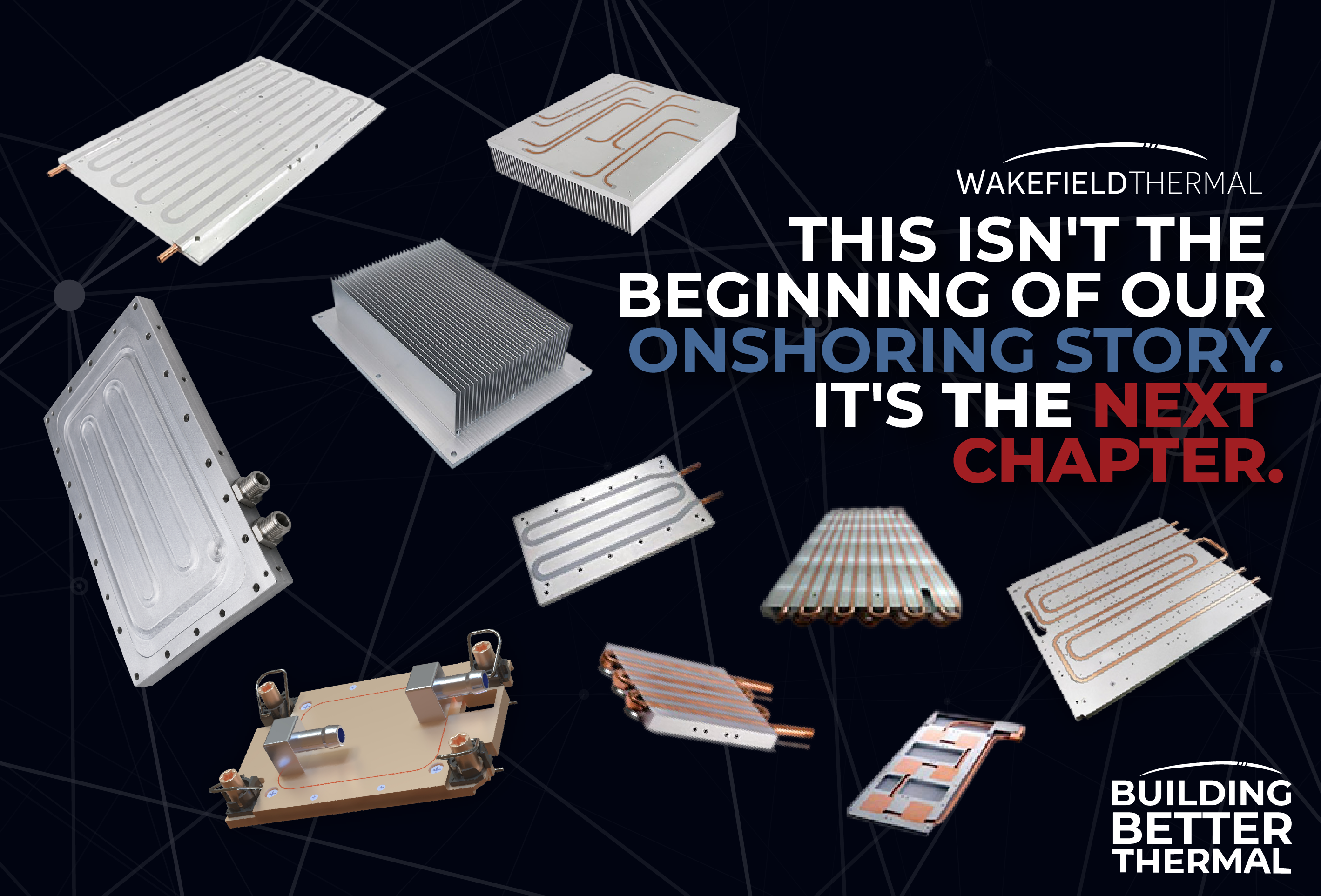
We're investing in additional capabilities including domestic skived fin manufacturing, friction stir welded cold plates, and an advanced liquid cooling center. These technologies extend the onshoring strategy beyond traditional air-cooled heat sinks and into the liquid cooling solutions required for increasingly demanding industrial and power applications.
Our objective is straightforward: reduce the number of thermal technologies that customers must source through fragmented or offshore supply chains.
Instead of coordinating extrusion from one supplier, machining from another, and advanced thermal manufacturing elsewhere, customers can work with a partner capable of managing more of the process domestically.
Importantly, onshoring doesn’t have to mean eliminating global manufacturing altogether. We maintain global manufacturing resources for programs where volume and cost requirements make offshore production advantageous.
The difference is choice. Customers can select a domestic manufacturing strategy when speed, tariff exposure, supply continuity, or engineering collaboration are priorities while retaining global options for cost-sensitive programs.
The Market Shifted, But Our Commitment Didn't: From Component Cost to Supply Chain Value
The conversation around onshoring ultimately needs to move beyond the purchase price of an individual component.
Manufacturers must consider tariffs, freight, inventory requirements, lead-time variability, engineering responsiveness, production interruptions, and the financial impact of a component arriving late.
When those factors are considered together, our domestic manufacturing can represent much more than an alternative source. It can become a strategy for reducing risk.
We've believed in that value since 1957.
While others work to bring capabilities back to the United States, we're building on the domestic infrastructure, expertise, and vertical integration we've maintained for decades.
This isn't the beginning of our onshoring story. It's the next chapter. It's the next investment in a strategy we've been committed to all along.