 US Dollars


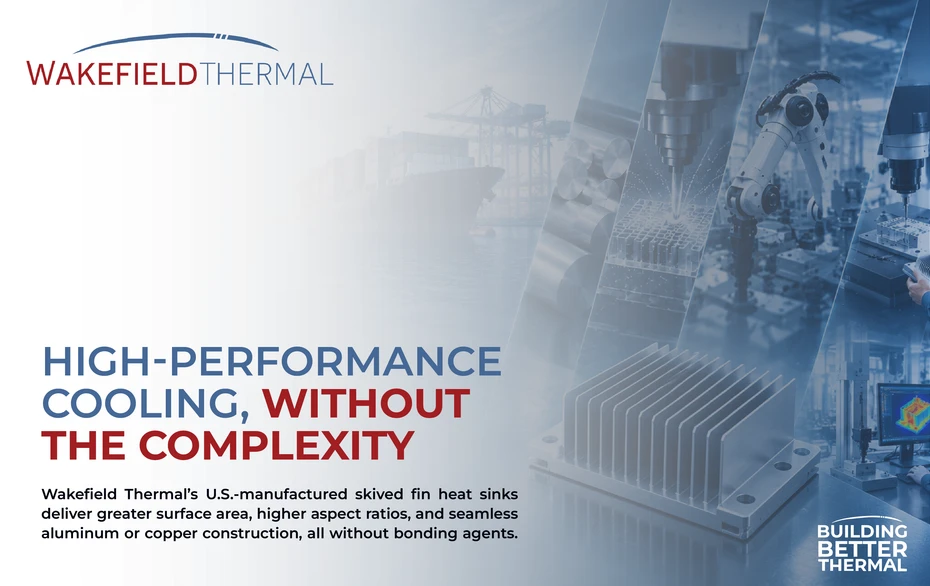
When dealing with high-power electronic devices that are now generating more heat within increasingly compact packages, traditional extruded heatsinks are reaching their practical thermal performance limits.
Moving to liquid cooling straight away, however, can add cost, complexity, and infrastructure requirements that may not be necessary for every type of application.
High-performance air-cooled skived fin heatsinks offer an alternative where extrusion reaches its limits, or where a bonded interface is a thermal concern.
Conventional bonded fin construction requires bonding agents, but skived fin manufacturing creates high-aspect-ratio heatsinks from aluminum or copper with no bonding interface. The skiving process enables thin, closely spaced fins that increase available surface area for heat transfer while maintaining a uniform material structure between the base and fins.
For applications including motor drives, IGBT cooling, UPS systems, welders, inverters, rectifiers, and high-power resistors, skived fin technology can provide the additional air-cooled thermal performance needed to manage increasing heat loads and potentially delay or eliminate the need to transition to more complex liquid cooling infrastructure.
What Is Fin Aspect Ratio?
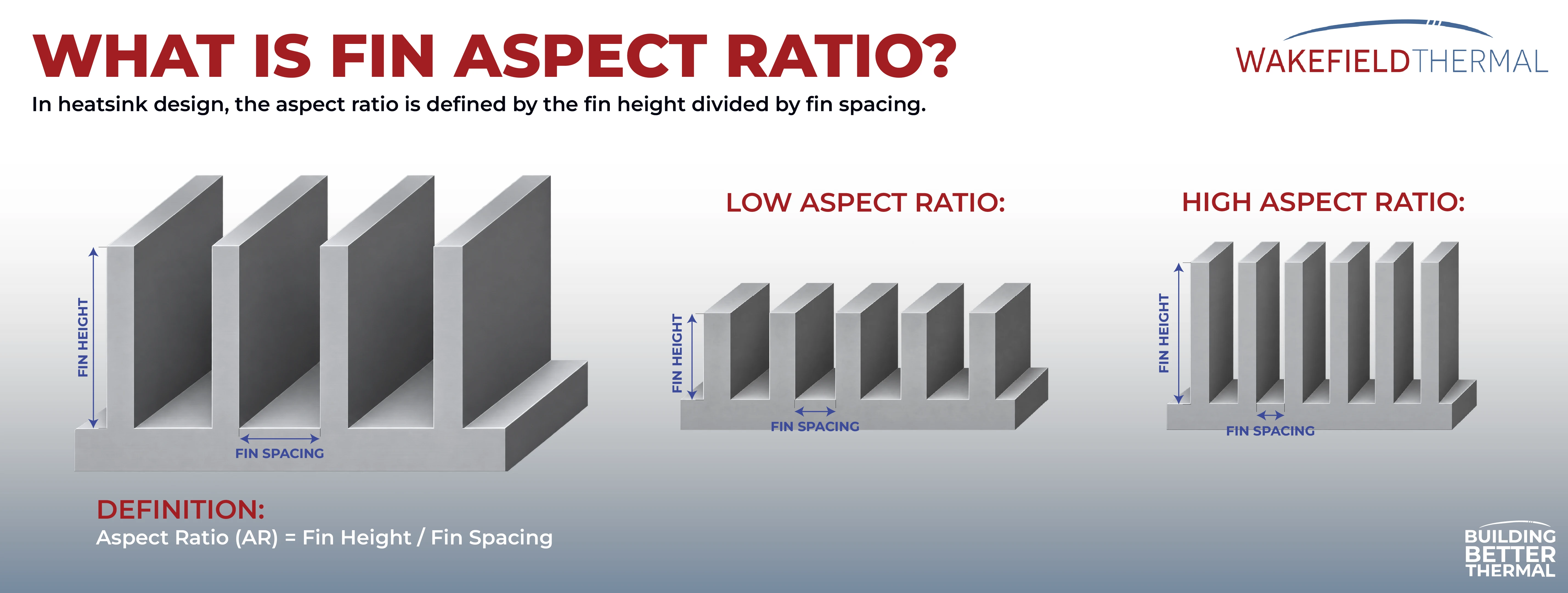
In heatsink design, the aspect ratio is defined as the fin height divided by fin spacing. This aspect ratio can be used to characterize one trait of difficulty in manufacturing a heatsink shape. The higher the aspect ratio, the harder a heatsink can be to produce using methods like extrusion.
Higher aspect ratios can provide substantially more heat-transfer surface area within a given footprint, making them valuable when engineers need greater thermal performance without significantly increasing the overall cooling solutions volume.
What Is a Skived Heatsink?
A skived fin heatsink is manufactured by cutting and forming fins directly from a bar of aluminum or copper. Unlike a bonded fin heatsink, the fins aren’t manufactured separately and then attached to a base. Instead, the fins and base remain part of the same continuous piece of material.
This uniform construction eliminates the bonding layer between the fins and base while allowing manufacturers to create fin geometries that can exceed the practical aspect-ratio limitations of conventional aluminum extrusion.
This results in a heatsink that’s capable of combining thin fins, tight fin spacing, high fin density, and tall fin structures to increase the surface area available for air-cooled heat transfer.
How Does the Skived Fin Manufacturing Process Work?
One of the easiest ways to understand skiving is to imagine running a knife across the top of a stick of butter.
As the knife moves forward, it lifts a thin curl of material that stays attached at the base. The knife then bends the thin layer upward and the process repeats.
Skived fin manufacturing follows a similar principle, except with precisely controlled industrial tooling and a solid aluminum or copper bar.
Aluminum provides an effective combination of thermal conductivity, low weight, manufacturability, and cost, making it appropriate for a wide range of forced-air cooling applications.
Copper provides significantly greater thermal conductivity and may be advantageous when high heat flux or spreading resistance makes thermal performance the dominant consideration.
The process begins with an aluminum or copper base bar, which can be produced in long lengths and widths up to approximately 305 mm depending on the design. The material is loaded into the skiving machine, where specialized tooling engages the bar’s surface.
A blade, or series of blades, cuts into the material at a carefully controlled depth, angle, and speed. Rather than removing the material as a chip, the process raises the thin section of metal from the base and forms it vertically into a fin.
The tool retracts, advances to the specified spacing, and repeats the process.
This sequence continues down the bar’s length until the required fin field has been created. The material is then cut to the final heatsink length, and the tops of the fins can be machined to establish a consistent finished height.
Because each fin is formed directly from the base material, there’s no separate fin-to-base bond.
From Raw Material to a Finished Thermal Solution
Skiving is only one part of producing a finished heatsink.
After the fin structure has been formed, the heatsink can undergo additional CNC machining to meet the applications requirements. Features can include:
- Pockets and relief areas
- Pedestals and raised mounting surfaces for component interfaces
- Mounting holes and hole patterns
- Application-specific base geometries
- Other CNC-machined features
Surface treatments can also be selected based on the material and application. Aluminum skived fin heatsinks can be anodized or chromated, while copper solutions can receive antioxidation treatments or nickel plating.
For applications requiring additional thermal performance, skived fin heatsinks can also be integrated with heat pipes and other thermal technologies to move heat more effectively from concentrated heat sources into the fin field.
Why Skived Fin for IGBT Cooling and High-Power Electronics?
Modern IGBT devices and power electronics are producing greater thermal loads within compact package sizes. That creates a difficult engineering challenge: How do you increase cooling performance when the available space and operating environment remain relatively unchanged?
An extruded heatsink may not provide sufficient fin density or surface area within the available envelope. At the other end of the spectrum, converting the system to liquid cooling may require pumps, plumbing, coolant distribution, monitoring, maintenance, and other infrastructure.
Skived fin can provide an important intermediate solution.
By creating thinner and more closely spaced fins than conventional extrusion can typically achieve, skiving can increase heat-transfer surface area within a similar physical volume. A properly designed fin geometry can also provide more favorable airflow characteristics (surface area vs pressure drop) compared with extruded geometries.
For some applications, that additional performance can allow engineers to extend the capabilities of air cooling before making the jump to liquid cooling.
Skived Fin vs. Extruded and Bonded Fin Heatsinks
There’s no single heatsink manufacturing technology that’s ideal for every thermal application.
Extruded heatsinks offer proven, economical performance across a broad range of applications, but the extrusion process places practical limitations on fin thickness, spacing, and height.
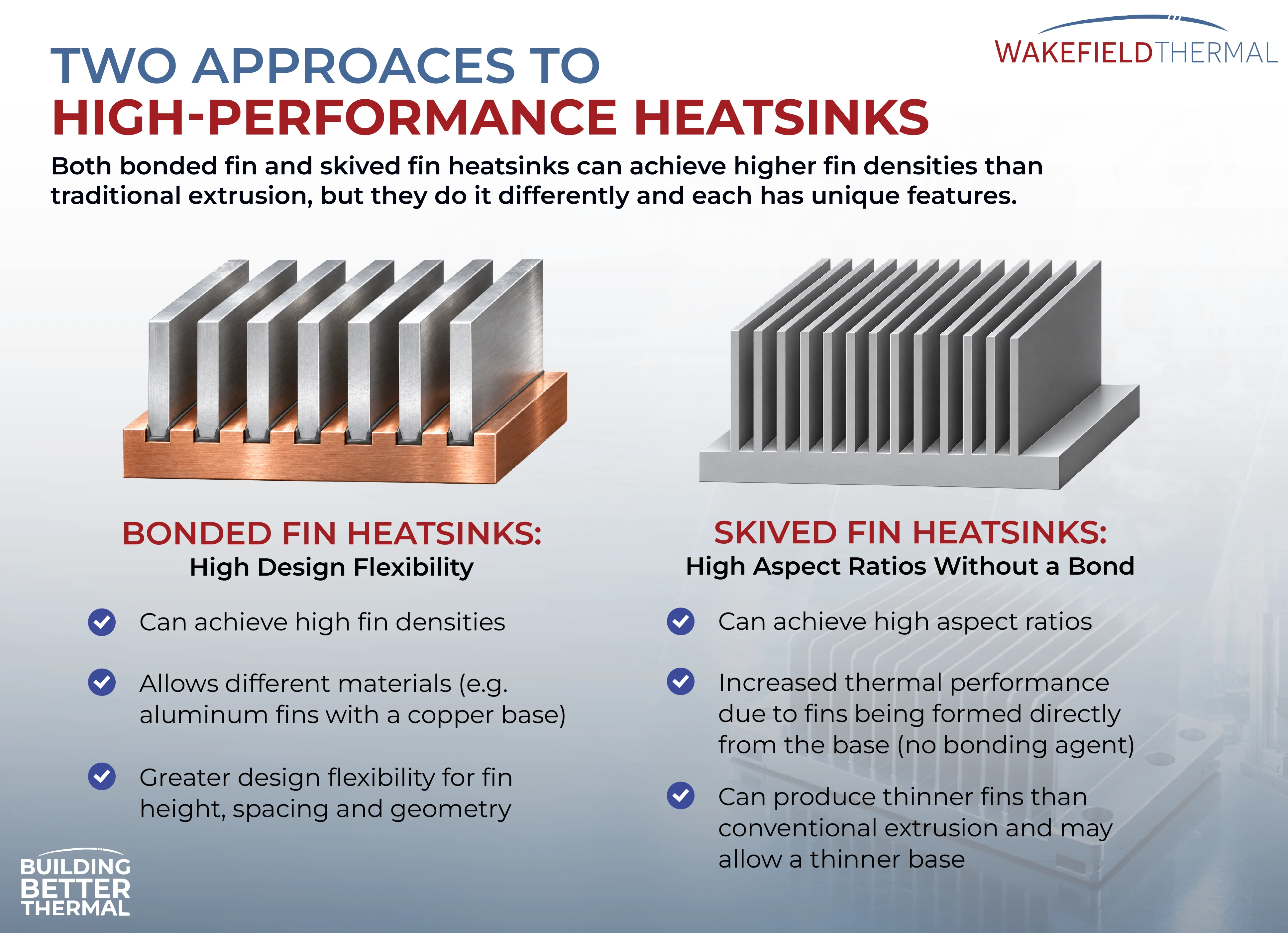
Bonded fin heatsinks can overcome many of those geometric restrictions of the extrusion process by manufacturing the fins separately and attaching them to a base. This enables high fin densities and can allow designers to combine different materials, such as aluminum fins with a copper base. However, a bonded fin solution requires a joining interface between the base and fins. While manufacturers keep the width of the bond small and use a thermally conductive bonding agent, that agent adds resistance to the heatsink and can negatively impact the overall thermal performance.
Skived fin heatsinks provide another approach. Because the fins are formed directly from the base, they can achieve high aspect ratios without introducing a bonding agent between the fins and base. Skiving can also produce thinner fins than conventional extrusion and may allow a thinner base than some bonded fin constructions.
There are tradeoffs. Skiving has practical limitations on airflow length and manufacturable geometry. Thin skived fins can also be more susceptible to physical damage than heavier extruded fins, and creating varying fin heights or complex fin profiles can be more challenging than with certain extruded or bonded designs.
The right technology therefore depends on the thermal load, airflow, available envelope, pressure drop, materials, mechanical requirements, production volume, and target cost.
Wakefield Helps You Choose the Right Heatsink Technology
The advantage of working with Wakefield goes beyond having access to skived fin manufacturing. Because we have extensive capabilities in extruded, bonded fins, and skived fin heatsinks, our engineers can evaluate multiple manufacturing technologies rather than trying to make one solution fit every application.
Selecting the right heatsink requires balancing thermal performance with factors. Wakefield’s thermal engineering team can analyze these variables to predict performance and determine which heatsink technology provides the right balance for the application.
For some designs, a traditional extruded heatsink may provide all the cooling performance required while offering an economical and proven manufacturing approach.
Applications with higher heat loads or tighter space constraints may benefit from the skived fin heatsink’s increased surface area, thinner fins, and uniform construction. Other applications may require the design flexibility of bonded fin construction, the addition of heat pipes, or eventually a transition to liquid cooling.
Having these technologies available within Wakefield gives our engineers the flexibility to evaluate the application as a complete thermal challenge. Instead of starting with a predetermined manufacturing process, we can begin with the customer’s performance requirements and work toward the solution that makes the most technical and economic sense.
Contact the Experts to Start Your Skived Fin Design
Choosing skived fin starts with assessing the application’s thermal and mechanical requirements. Wakefield’s engineers evaluate these factors to plan the fundamental design.
From there, additional requirements can be incorporated into the finished heatsink, including pedestals, hole patterns, machined pockets, and other application-specific features. These inputs guide fin geometry, surface area, airflow, pressure drop, heat spreading, and manufacturability optimization.
This engineering-driven approach is especially valuable when extruded heatsinks near their performance limits. For IGBTs and other high-power electronics, skived fins can improve air-cooled performance without the infrastructure and complexity of liquid cooling.
With thermal analysis and in-house expertise across multiple heatsink technologies, Wakefield can help determine whether skived fin is the right solution for the application.