 US Dollars


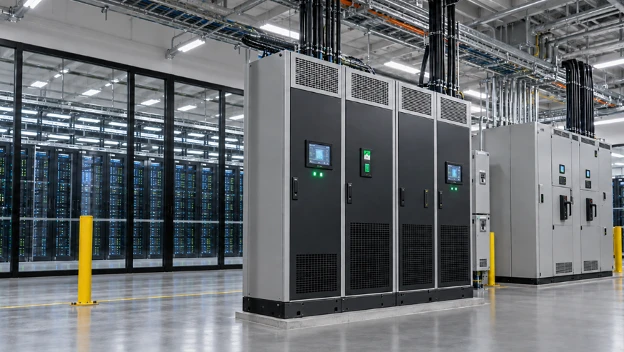
Industrial facilities, data centers, and manufacturing environments need more reliable power. That puts pressure on uninterruptible power supply (UPS) manufacturers to deliver more capacity without making their equipment bigger.
Higher-capacity UPS systems rely on more powerful electronic components, and those components produce more heat. The heat is especially hard to manage when manufacturers want to keep their existing enclosure dimensions, airflow systems, and mechanical configurations.
One UPS manufacturer needed to raise heat sink thermal performance by about 15% to support power devices rated about 25% higher. It had to do this without making the heat sink larger or replacing the existing cooling fans.
Wakefield Thermal ran a full engineering evaluation of extruded, bonded fin, and skived fin heat sink technologies. We chose a high-power skived fin solution that delivered the extra cooling the customer needed and still fit the existing system design.
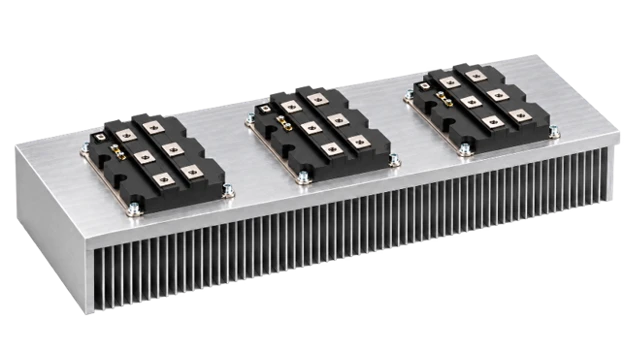
The Challenge: Increasing UPS Power Capacity Within an Existing Design
The customer manufactured UPS systems used in data centers, industrial operations, and manufacturing facilities. These systems relied on high-power electronic devices to manage electrical power and maintain reliable operation.
The existing UPS design used air-cooled heat sinks manufactured through conventional extrusion and bonded fin technologies. Fans mounted inside the enclosure directed airflow through the duct and across the heat sink fins, carrying heat away from the electronic components before exhausting the warmed external air.
This configuration effectively cooled the heat generated by the the existing power devices. However, the customer wanted to introduce higher-capacity UPS products using more powerful components.
The increased power requirements created a significant thermal management challenge.
The customer needed approximately 15% better heat sink thermal performance to support devices with approximately 25% higher power ratings. At the same time, the upgraded heat sink had to fit within the same physical space and operate using the existing fans.
The system also needed to maintain performance under specified environmental conditions, including an ambient temperature of 40°C.
Increasing the heat sink size, modifying the duct, or upgrading the fans could have required extensive mechanical redesign, additional engineering validation, and changes to the existing product architecture.
The objective was to achieve greater cooling performance without changing the established mechanical envelope.
Evaluating the Limits of Traditional Heat Sink Technologies
Rather than recommending a manufacturing method right away, we began by evaluating the customer's existing thermal solution. Because we manufacture extruded, bonded fin, and skived fin heat sinks, our engineering team could compare each option on thermal performance and manufacturability.
Using customer-provided data on heat load, airflow, available volume, and environmental conditions, our engineers ran thermal simulations to establish the existing extruded heat sink's performance.
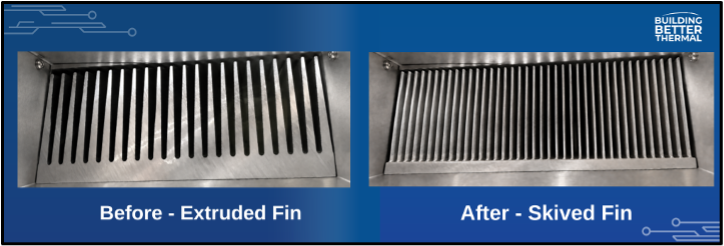
The first approach focused on optimizing the extrusion geometry, since thinner, more densely spaced fins would add heat-transfer surface area within the same volume. However, extrusion manufacturing limits how thin and closely spaced fins can be.
As the design approached those limits, we evaluated bonded fin technology. Producing fins separately and attaching them to a base allows higher fin densities and more flexible geometries than conventional extrusion. However, the bonding layer between the fins and base can add thermal resistance, even when thermally conductive bonding agents are used.
In this application, simulations showed that the bonded fin approach couldn't deliver the required improvement. The evaluation pointed to a specific set of characteristics: thin fins, high fin density, more heat-transfer surface area, and a continuous metal structure with no bonding agent. That made skived fin technology the next logical solution.
The Solution: High-Power Skived Fin Heat Sink Technology
Skived fin manufacturing uses a precision cutting and forming process to produce thin fins directly from a solid bar of aluminum or copper. Unlike bonded fin heat sinks that attach separately made fins to a base, skiving forms each fin from the base material itself, which creates a continuous metal structure with no bonding layer. It also allows high-aspect-ratio geometries that go beyond what conventional extrusion can practically achieve.
For the UPS application, we proposed a skived fin heat sink with thinner fins and higher fin density than the customer's existing extruded design. This added heat-transfer surface area within the same volume. However, since higher fin density doesn't automatically improve cooling.
Our engineers designed the geometry around the customer's existing airflow and balanced fin geometry, airflow, and thermal performance to avoid a fan upgrade.
Thermal simulations confirmed that the optimized design met the customer's performance requirements within the original heat sink envelope.
Thermal Simulation and Customer Validation
Simulation was a critical part of the development process because it allowed us to compare manufacturing technologies and evaluate performance before producing physical samples.
The engineering team used the customer's operating requirements to model the proposed skived fin geometry and predict its thermal behavior.
The analysis showed that the skived fin design could provide the required thermal improvement within the available space while operating with the existing fin configuration.
Following the simulation phase, we manufactured physical samples for customer evaluation. The customer then tested the samples under its application requirements to verify that the heat sink provided the desired thermal performance.
Customer testing validated that the skived fin solution met the required thermal performance targets.
This progression from simulation to prototype testing helped reduce development uncertainty while confirming that the proposed manufacturing technology was appropriate for the application.
The Results: Higher Thermal Performance Without a System Redesign
The engineering solution addressed the customer's primary thermal and mechanical requirements.
| Performance Requirement | Result |
|---|---|
| Thermal performance | Approximately 15% improvement achieved |
| Higher-power devices | Supported the planned approximately 25% increase in device power rating |
| Heat sink volume | Maintained existing envelope |
| Cooling fans | Retained existing fans |
| Mechanical integration | Fit within existing duct configuration |
| Validation | Simulation and customer sample testing |
With the improved heat sink added to the established product architecture and no major mechanical redesign needed, the manufacturer can bring its higher-capacity UPS products to market faster.
In markets where power density, development schedules, and equipment footprint matter, raising performance without redesigning the whole system can be a significant competitive advantage.
Wakefield Thermal: Finding the Right Technology for the Application
One of the most important aspects of this project was our ability to evaluate multiple heat sink manufacturing technologies before selecting the final solution.
As a vertically integrated thermal management manufacturer, Wakefield offers extensive capabilities in extruded, bonded fin, and skived fin heat sinks. This allows our engineering team to evaluate the advantages and limitations of each technology rather than approaching every application with a predetermined manufacturing method.
Power electronics continue to evolve, so Wakefield Thermal remains steadfast in helping manufacturers evaluate the right combination of thermal performance, manufacturability, cost, and system integration.
If you're looking to increase thermal performance without increasing heat sink size, then contact Wakefield Thermal to explore how our engineering and skived fin manufacturing capabilities can support your next high-power application.