 US Dollars


In thermal management, performance is only part of the equation. Manufacturers need confidence that the products they design into their systems will be available when they need them, at predictable costs, and with the quality and consistency their applications demand.
That is becoming increasingly difficult when critical components depend on complex global supply chains.
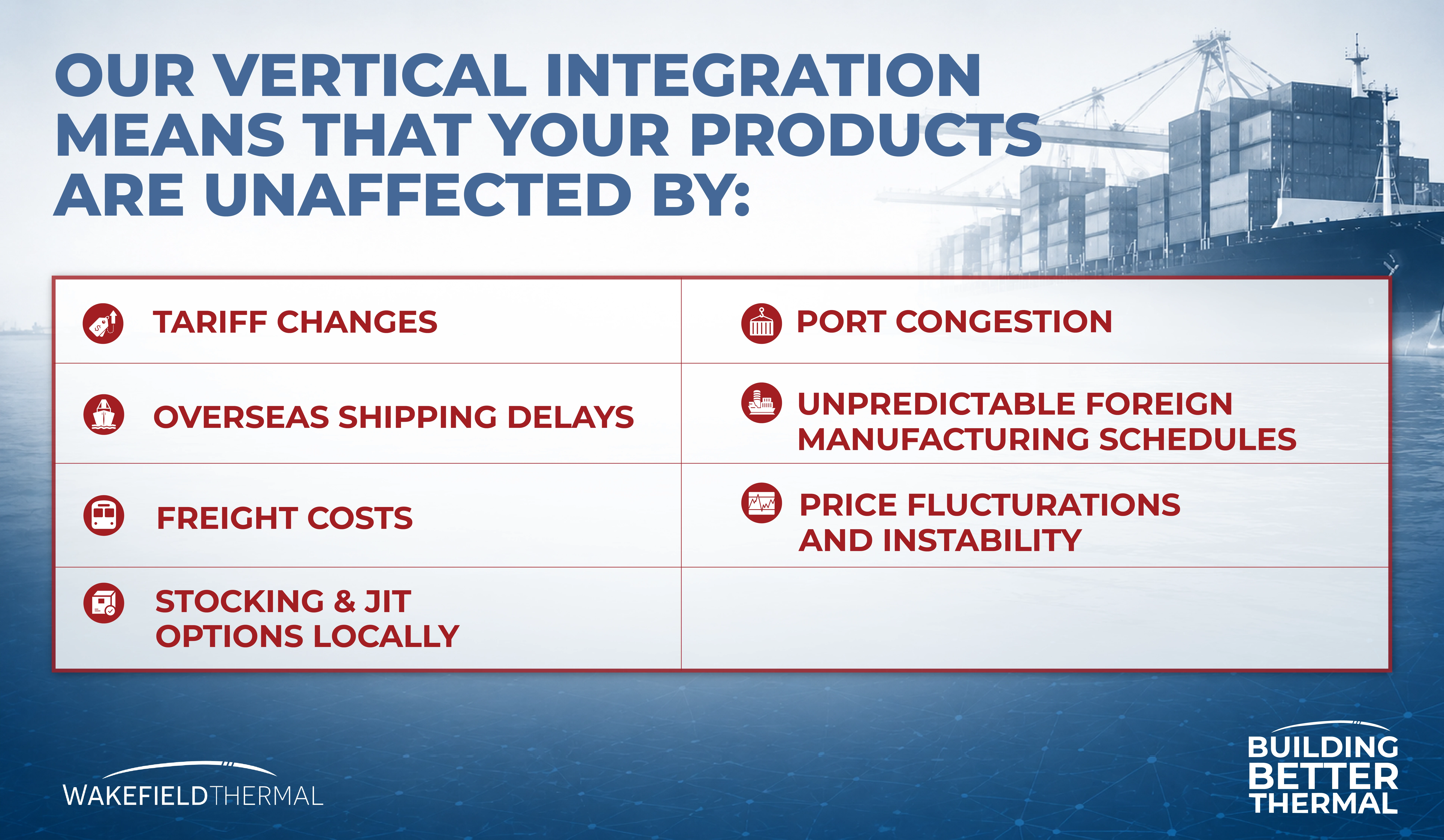
Tariff changes, port congestion, international freight costs, overseas production delays, and pricing instability can quickly turn a straightforward sourcing decision into a significant business risk.
When each manufacturing step is broken up and divided among multiple suppliers across multiple countries, customers have limited control over these variables.
Wakefield Thermal takes a different approach.
Wakefield is one of the world's leading complete end-to-end and vertically integrated thermal solutions companies. With more than 50 years of experience solving cooling challenges at the component, system, and facility level, we combine engineering expertise with extensive domestic manufacturing capabilities.
While competitors may depend heavily on outsourced offshore production, we manufacture critical thermal products and components right here in the United States. That vertical integration gives our customers something that's only increasing in value: greater control over their thermal supply chain.
What Does Vertical Integration Mean in Thermal Management?
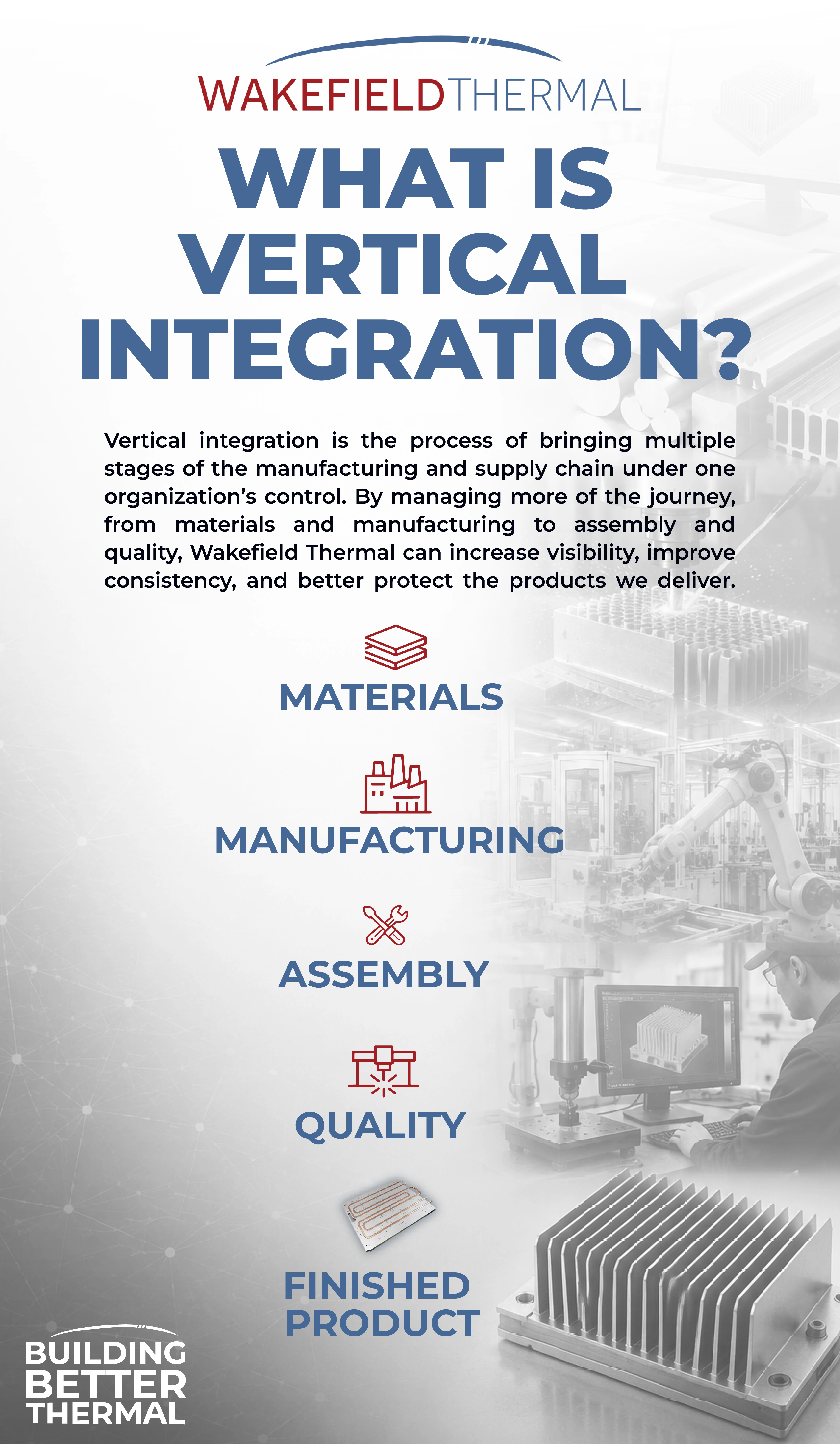
Vertical integration means controlling more of the processes required to transform an idea into a finished product instead of relying on a network of outside suppliers.
For Wakefield, that starts with one particularly important capability: aluminum extrusion.
We operate our own extrusion capabilities, allowing us to control the production of one of the fundamental building blocks of air-cooled thermal management. That capability has helped us develop the largest standard offering of heat sink extrusions in the country.
But extrusion is only the beginning.
Our capabilities extend through machining, fabrication, thermal engineering, finishing, assembly, and other manufacturing processes required to deliver complete thermal solutions. Combined with multiple production facilities and our global reach, this allows us to support customers from initial design and prototype development through production.
Instead of managing one vendor for an extrusion, one vendor for machining, another vendor for assembly, and yet another for a finished thermal solution, customers can stick with us throughout the entire process, start to finish.
That means fewer handoffs, greater accountability, and a more direct path from concept to production.
Greater Stability in an Unpredictable Supply Chain
One of the most important benefits of vertical integration is reducing the number of outside variables that can affect cost and delivery.
Tariffs are a prime example. A component that initially appears less expensive to manufacture overseas may become substantially more costly when tariffs, duties, freight, and other import-related expenses are factored into the landed cost. Changes in trade policy can introduce additional uncertainty, particularly for long-running programs where unexpected cost increase can affect margins, budgets, and pricing commitments.
For products we manufacture in the United States, customers don't have to build the same international tariff uncertainty into their sourcing strategy. Domestic production provides a more predictable foundation for planning.
The same principle applies to logistics.
A thermal component can't perform its job if it's sitting on a container ship or waiting to clear a congested port.
International sourcing introduces variables that neither the customer nor manufacturer can completely control. Port congestion, shipping disruptions, container availability, customs processing, and changing international trade routes can all affect when products actually arrive.
Foreign manufacturing can introduce another layer of uncertainty. When suppliers outsource production, their customers are ultimately dependent on a third-party manufacturer's capacity, production schedule, labor availability, material access, and priorities. A disruption thousands of miles away can quickly become a production problem in the United States.
Vertical integration gives us greater control over those variables.
Our teams can coordinate engineering and manufacturing internally, giving us better visibility from prototype through production. If requirements change, there are fewer outside organizations standing between the customer and the manufacturing process.
The result is a supply chain built around greater accountability, stability, and predictability.
More Flexible Stocking and Supply Options
Not every customer needs the same supply strategy.
Some applications benefit from maintaining local inventory to ensure product is readily available. Others operate using JIT models designed to reduce inventory and receive components closer to when they are needed.
Our domestic manufacturing footprint provides greater flexibility to support both.
With production located closer to our U.S. customers, we can work with partners on stocking programs and JIT strategies without relying on the extended replenishment cycles associated with overseas shipping. Customers can reduce the need to compensate for long international lead times with excessive safety stock while maintaining confidence in product availability.
This proximity also makes it easier to respond when demand changes. Rather than waiting for the next international shipment or planning requirements months in advance, a shorter supply chain can provide greater flexibility to adjust to changing production needs.
Faster Time to Market from Prototype to Production
Vertical integration isn't only a supply chain advantage. It can also accelerate product development.
Thermal management solutions often evolve during the design process. Engineers may need to adjust dimensions, evaluate different materials, modify fin configurations, test prototypes, or optimize a solution based on thermal performance.
When each manufacturing step belongs to a different vendor, those changes can require communication across multiple organizations and additional shipping between facilities.
At Wakefield, engineering and manufacturing work together.
By controlling more of the process internally, we can provide greater continuity as a product moves from prototype to production. Fewer handoffs can mean faster communication, quicker adjustments, and ultimately a faster path to market.
And when an issue does arise, customers know who is accountable. There's no need to determine whether a delay originated with an extruder, machine shop, offshore factory, freight provider, or another subcontractor.
We own the process.
One Partner for the Complete Thermal Solution
Ultimately, the greatest advantage of vertical integration is simplicity.
Thermal challenges are becoming more complex, but the supply chains supporting them don't have to become more complicated.
Our combination of thermal engineering expertise, in-house extrusion, domestic manufacturing, multiple production facilities, and global reach allows us to support our customers with solutions designed around both performance and supply chain requirements.
Customers gain fewer vendors to manage, less exposure to international logistics, greater manufacturing visibility, more predictable lead times, and full accountability from prototype through production.
At the same time, domestic manufacturing is only one part of our overall footprint. Through our global operations, including our own manufacturing capabilities in China, we can also support customers who need production and technical support closer to their markets.
Rather than depending on outsourced offshore vendors, our global capabilities remain part of the Wakefield manufacturing network, giving customers greater flexibility to choose the sourcing strategy that best fits their application, location, volume, and cost requirements.
That combination is an important distinction. We can provide the benefits of vertically integrated US manufacturing when domestic production, speed, supply-chain security, and tariff exposure are priorities, while maintaining global capabilities when customers need a different manufacturing strategy.
While other thermal providers continue to depend heavily on outsourced offshore manufacturing, we have spent decades building a different model.
We build in the U.S. We control critical manufacturing processes. We give our customers a faster, more predictable path from thermal challenge to finished solution.
While the market is subject to change, our commitment remains solid. This isn't some new strategy for us; these advantages have been embedded in a manufacturing infrastructure we've been developing for generations.
We're just doubling down on what we've always done.